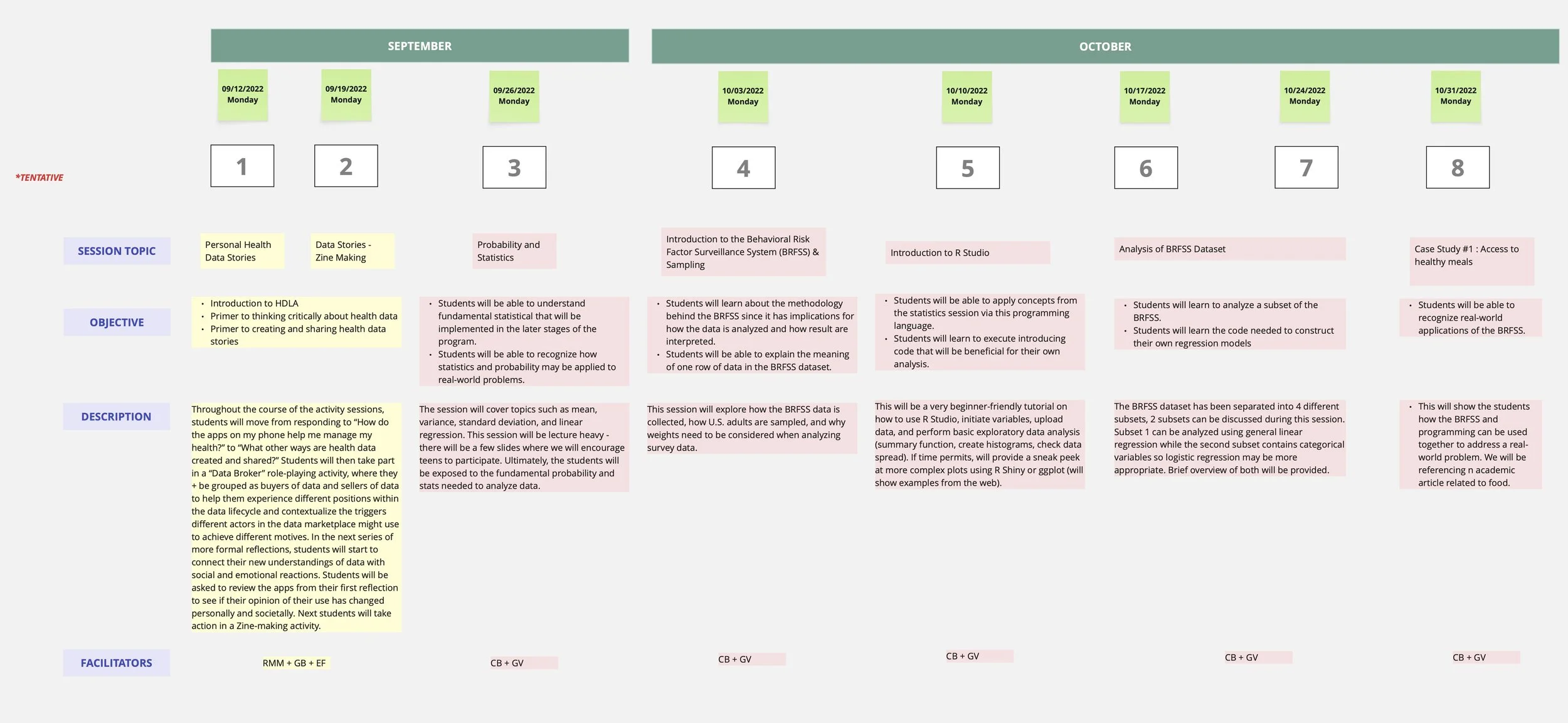
HDLA program overview
About
High school-aged youth routinely share personal and health data through mobile apps, social media, and school platforms often with limited understanding of how that data is collected, stored, and used. Yet existing digital literacy efforts rarely address the specific privacy implications of health-related data, or equip young people to critically evaluate the systems they interact with daily. The Health Data Literacy Ambassadors program was designed to close that gap, giving teens the tools to engage with health data analytics, interrogate how their data moves through systems, and become advocates for data literacy in their own communities
Process
I co-designed and facilitated three data privacy workshops for 20+ high school participants. The workshops covered:
How personal data collection works in the apps and platforms youth actually use
Privacy implications of mobile health applications specifically
Ethical data storytelling - how to visualize and communicate data responsibly
Beyond the workshops, I led the structuring and delivery of a 16-week pilot program, coordinating multiple instructors and serving as the primary liaison for youth participants. I worked on the IRB proposal, detailing data collection, storage, and anonymization procedures to protect participant confidentiality.
To develop the curriculum, I curated and analyzed existing case studies, curricula, and frameworks, adapting them into activities that could engage young learners in complex topics without condescending to them.
Impact
3 workshops delivered to 20+ youth participants
16-week pilot program successfully structured and delivered
IRB proposal approved
Insights from this work directly informed the direction of my dissertation on age-appropriate AI
Role: Co-Designer, Facilitator
Timeline: Aug 2021 - Dec 2022
Location: University of Illinois Urbana-Champaign
Research Team: Dr. Rachel Magee, Dr. Catherine Blake, Emily Fishkin
Funded by: Illinois 4-H Extension Collaboration Grant
Participants: 20+ high school youth
Methods: Co-design, Workshop Facilitation, Survey, Contextual Inquiry, IRB Protocol Development
Output: 3 data privacy workshops, 16-week pilot program, approved IRB proposal